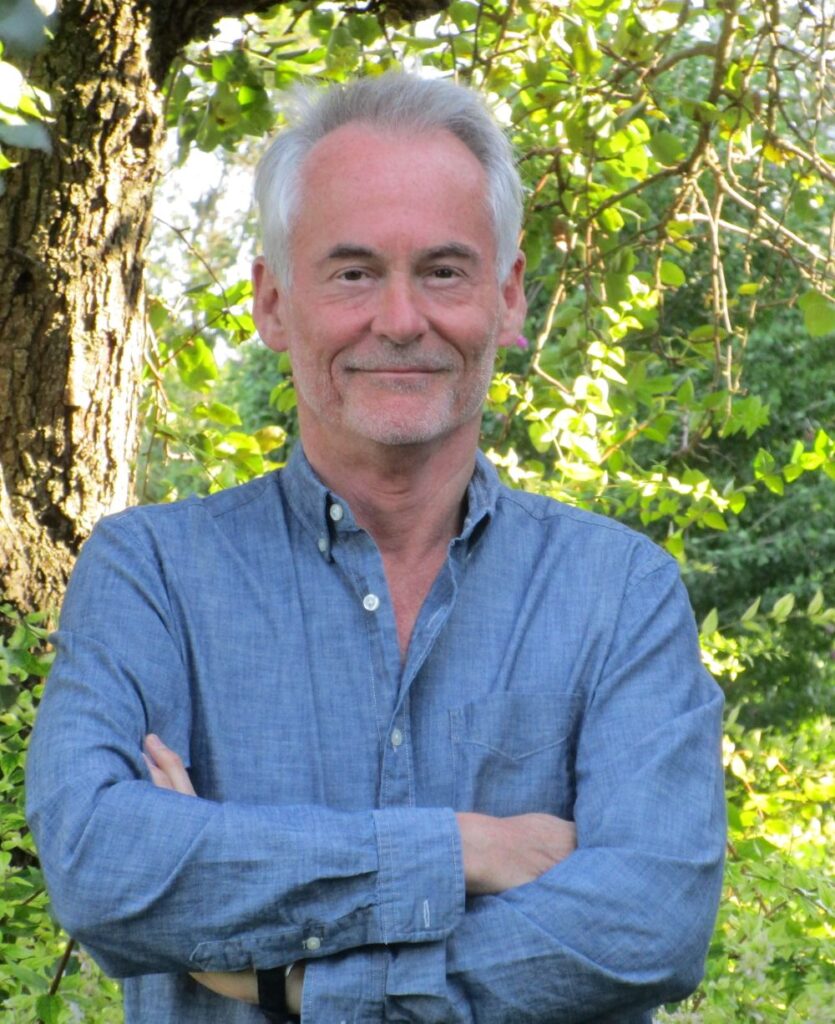
Between 1997 and 2002 he worked for the British Government as Director of Communications and Press Secretary to several cabinet ministers. He is now an author, presenter and journalist.
He was a consultant on the BBC2 political sitcom The Thick of It and the 2010 movie In the Loop. In 2013, his book The Lost Child of Philomena Lee was adapted into the film Philomena, starring Judi Dench and Steve Coogan in the role of Martin Sixsmith. It was nominated for four Oscars.
His non-fiction books include My Sins Go With Me, a story of bravery and treachery in the Dutch Resistance; Ayesha’s Gift, the story of a young woman’s search to discover the truth after her father is murdered in Pakistan; Moscow Coup; The War of Nerves – Inside the Cold War Mind; and Putin and the Return of History.
In 2014 he presented the BBC’s 25-part history of psychology and psychiatry. He is currently working on a book about the alarming similarities between Donald Trump and Vladimir Putin, and a musical version of Philomena.
Summary
Vladimir Putin is a paradox. In the early years of his presidency, he appeared to commit himself to friendship with the West, suggesting Russia could join the European Union or even NATO. But the Putin of those years is now unrecognisable, an autocratic nationalist dedicated to repression at home and anti-Western militarism. So, what happened? Was he lying from the start? Or, if was he sincere, what was it that made him change his mind? Martin Sixsmith examines these questions in the context of Russia’s history and asks if the West must shoulder some of the blame.
Review by Croy Thomson
Martin Sixsmith – Putin, Trump and the New Cold War 28.11.25
So, comrades, MAGA fans and everyone opposite and in between, welcome back to when
the West went tank-to-tank against those pesky Russkies at Berlin’s Checkpoint Charlie.
Martin Sixsmith, ex-BBC political correspondent extraordinaire, delivered an eloquent, lively, well-illustrated talk that clarified what most of the full-house audience probably already believed: President Putin distrusts the West and cannot be trusted himself; President Trump is a wannabe king who’ll sell US policy to the highest bidder. A dangerous New Cold War is under way, but how did we get here, after the idyll of peace and prosperity that was the 1990s and the noughties? Were those happy decades a mere blip in the usual continuum of strife?
Martin Sixsmith briskly gave us the historical context of Russia’s convulsive years after the fall of the Berlin Wall, the disastrous attempt at a free-market economy, and the broken “promise” by NATO to move its missiles “not one inch east”. (Sixsmith did ask how we’d react in Britain if a communist government in France – a not inconceivable notion – hosted Russian missiles in Boulogne?)
Contentions include that the Western powers grew complacent and assumed that not only was the Cold War over, but also that Russia was acquiescent. But the Russian bear was not tamed, it was only hibernating. Putin – an indicted war criminal – has invaded Georgia and Ukraine, annexed Crimea, pulverised Chechnya, collaborated with Syria’s Assad. Like a Russian doll, the one-time professed friend of the west Putin is a paradox within a conundrum within a warhead. As a former KGB man, Putin knows how to manipulate people – even a whole country – and Trump seems to be naive narcissist enough to fall for flattery from a “strongman” despot he admires. But everyone took flak, British politicians included.
It was noted that Trump and Putin are both democratically elected; both are dismantling democratic systems to establish autocracies. Yes-men and -women are handed authoritative positions (and even a chainsaw), while foreign policy is built on greed. Dissent is trampled.
Is nuclear war a possibility, with the nation that gave us Tolstoy, Tchaikovsky, Gagarin, and, er, Molotov? Yes, it is. But as Martin Sixsmith said at the end of his talk, “Do try not to worry.” One recalls the tagline of the movie Dr Strangelove: “How I learned to stop worrying and love the Bomb.” That was in 1964. It’s déjà vu all over again.
Effective use was made of archive visuals, some of it chillingly funny, such as the “Duck & Cover” videos made in 50s/60s USA, urging children to hide under their school desks should atomic annihilation ever come to town. Audience questions included “Who’s behind Putin?” (People even more hellbent on destruction than he is, apparently.) Other Q&A topics: hybrid warfare, re-armament, China’s rise, and does Putin have incriminating info on Trump?
Professor Pat Monaghan thanked Mr Sixsmith and presented him with the Minerva Medal and a Society paperweight. We retreated to the foyer and huddled under the tables.
Formerly a BBC Correspondent in Moscow, Washington, Brussels and Warsaw, Martin Sixsmith covered the presidencies of Gorbachev, Yeltsin, Bush and Clinton. From 1997 to 2022 he was Director of Communications for the UK Government. He was educated at Oxford, Harvard, the Sorbonne and in St Petersburg. The talk is available online