The organised visit by Glasgow Royal Philosophical Society for 2026 selected Leeds, a city described as the unofficial capital of Yorkshire. This location offered a perfect blend of rich industrial heritage and modern culture and therefore an obvious choice offering to concentrate an enquiring mind.
Our accommodation, Quebec’s Hotel, centrally found in Leeds, is a highly rated comfortable, 4-star boutique hotel housed in an 1891 Grade II listed Victorian building. A premises steeped in early city history.
The itinerary for the four-day excursion included a mixture of city, rural and industrial locations offering an opportunity to assess the cultural exploitation of wool, with its industrial local, national, and international impact.
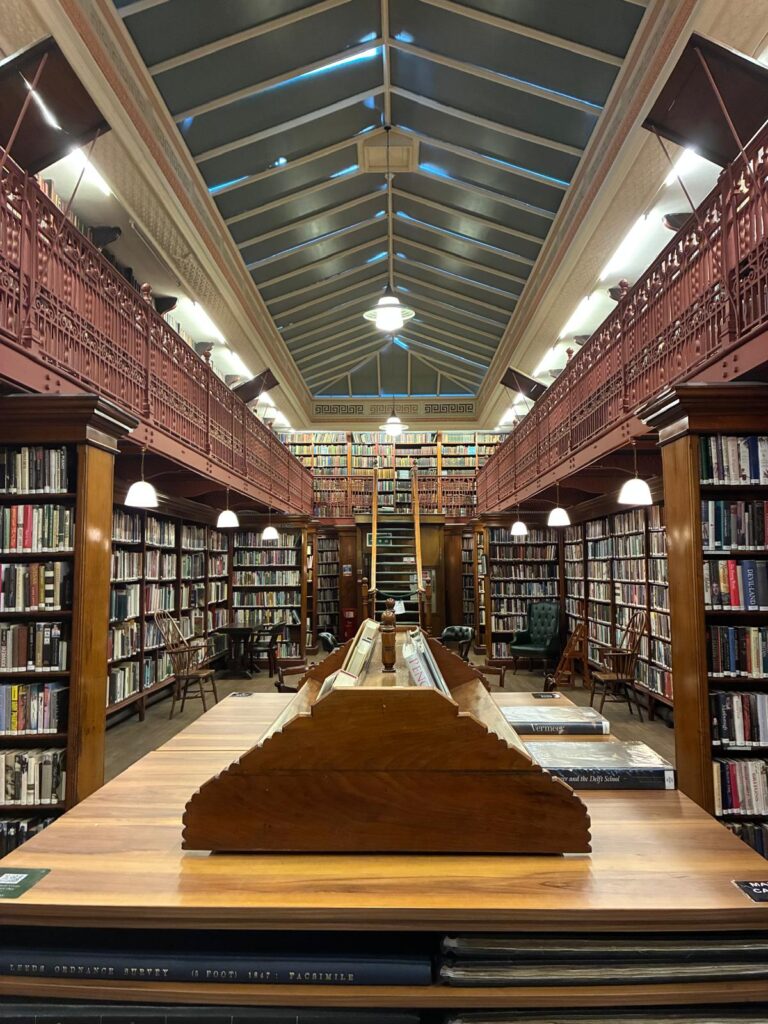
Commencing with a city tour our enthusiastic and distinctively attired guide Rachel Unsworth conveyed an in-depth knowledge of city history and architecture. Our walk offered an experience of new and old building designs, which blended with both the River Aire and city canal system. The tour ended inside Leeds Library, the oldest surviving subscription library of its kind in the British Isles. A tour of the library premises was conducted by Commercial Director Ian Harker, who described the history of the library by presenting interesting examples of rare and well known first edition books. The library also has a binding service, together with a treasure trove of national and local history publications.
Tony Burton, our organiser treated us to an in-depth lecture on wool, carefully crafting the subject, describing the origins of production for human usage and later commercialisation supervised by local Cistercian monks. This helped our appreciation when on Tuesday morning we visited Kirkstall Abbey, now a ruin, but brought to life by our guide, Sarah who described the history of the Abbey and the tough life the monks experienced. The industrial and commercial wool trade conducted by the monks locally and later internationally highlighted their mercantile skills.
Our next port of call was the extremely cavernous buildings of Leeds Industrial Museum at Armley Mills. Our enthusiastic guide carefully led us through the vast fireproof buildings constructed to counteract the dangerous process of manufacturing wool. A practical demonstration from the noisy mechanical loom highlighted the dangers to operators and children specifically employed to collect debris beneath the continuous operating machinery. After an explanation on the entire process, our visit culminated in a museum of clothing, displayed on mannequins, showing the finished product including military clothing and demob suits produced by Montague Burton, founder of one of Britain’s largest chains of clothes shops.
Returning to Leeds city centre we gathered at the premises of Carriageworks, Millennium Square to join members of Leeds Philosophical and Literacy Society, founded in 1819, for a presentation by Martin Elliot, Chief Planning Officer, Leeds City Council, who described the future plans for the city and surrounding areas. A lively discussion followed. Then we enjoyed time to mix socially with members of the Leeds Society.
Wednesday morning, we travelled to Wakefield to enjoy a cultural visit to the Hepworth Gallery; housed in a modern structure composed of ten trapezoidal blocks. Displayed within the building were modern sculptures, plaster and aluminium structures, paintings and drawings side by side with contemporary art all expertly explained by excellent guides. One painting of note was of the Tolbooth Glasgow, painted by L S Lowry.
Contrastingly, our afternoon visit took us outside to the Yorkshire Sculpture Park carefully providing a mixture of thought proving sculptures, again both modern and contemporary, set on a massive scale and harmonised with the natural beauty of the country park.
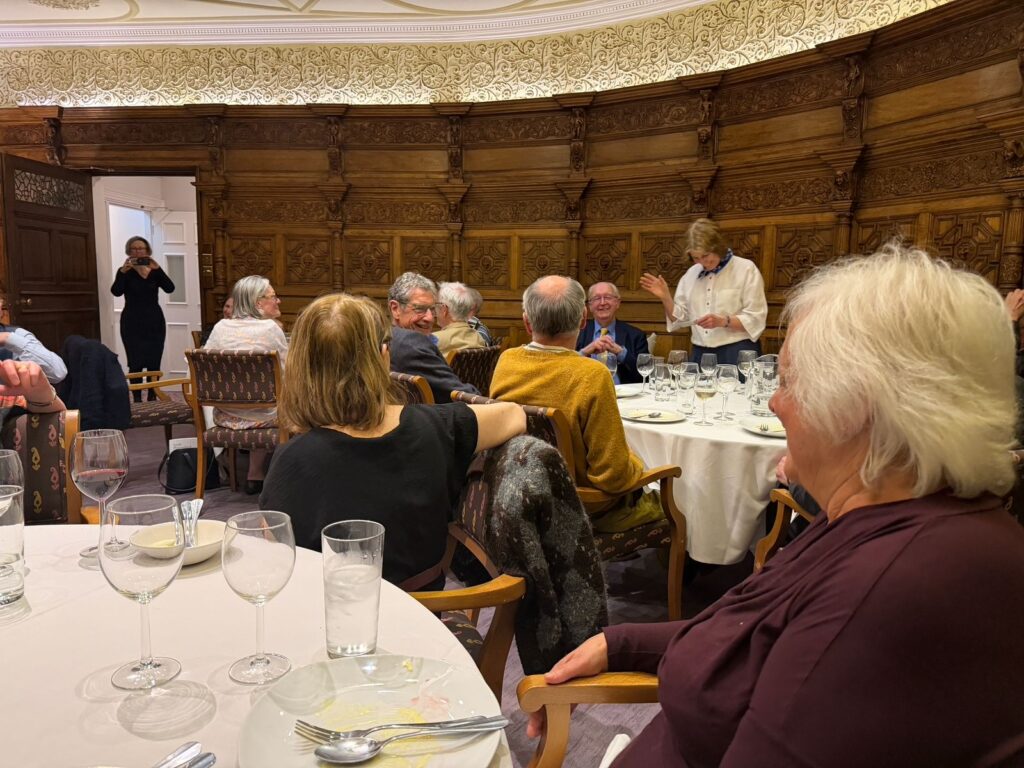
That evening, we hosted members of Leeds Philosophical and Literacy Society to a dinner within the Quebec’s Hotel’s Oak Room an exquisite oak panelled dining room. It was an excellent opportunity to meet socially and exchange experiences gained from membership of a Philosophical Society.
On Thursday, our last day began with a visit to the National Mining Museum, a previously working mine, which allowed a practical and visual experience of the mining industry. Our guide Rob led us through the ‘Time Tunnel’ designed to simulate the changes from manual labour to the introduction of mechanisation, emphasising the dangers of working conditions throughout the history of the industry. Despite the advances of safer procedures, such as the use of canaries and safety lamps, mining as an activity was extremely hazardous at every stage. Mining for coal in the early days was from the labour of desperate people in need of work and latterly by courageous miners who risked their lives to provide us with a product in great demand.
Our return journey to Glasgow included a visit to Salts Mill, near Bradford, a former textile Mill now incorporating an art gallery, shops, and restaurant. After a welcome lunch we visited the art gallery to enjoy an exhibition by David Hockney of his ’20 Flowers for 2025’ and other paintings.
Arriving home in early evening everyone agreed that this visit, like all the others, was very well organised, extremely interesting, educational, stimulating, and memorable.